By Florian Boymond | CEO, Stackmint
The enterprise AI rush has created a massive shadow IT problem. In the race to deploy generative AI, engineering teams and business units are spinning up "agents" and giving them direct access to mission-critical systems like Salesforce, SAP, and production databases.
This is a fundamental architectural flaw. When you give a probabilistic reasoning engine direct authority over deterministic business systems, you are not innovating—you are creating an unmanageable liability.
"The first step to successful AI governance is separating Intelligence from Execution."
The Danger of the "All-in-One" Agent
Large Language Models (LLMs) are brilliant at reasoning, classification, and data synthesis. But they are inherently probabilistic. They guess. They hallucinate. They drift.
You cannot hard-code corporate compliance, budget limits, or legal routing into a probabilistic engine. If the "brain" deciding what to do also holds the API keys to execute the action, you have zero egress control. A single bad prompt or hallucination can nuke a million-dollar pipeline, send an unauthorized discount to a client, or violate GDPR.
The Architecture of Control
To safely scale AI across an enterprise, you must decouple the Intelligence Domain from the Execution Engine.
This is the core philosophy behind Stackmint's governed execution infrastructure. As visualized in our architecture model, there must be a definitive, controllable gateway between thinking and doing.
- The Intelligence Domain: This is where the LLM lives. It ingests context, analyzes data, and proposes an action. It has zero authority to execute.
- The Governed Gateway: This is the Stackmint control plane. Before any proposed action can pass through, it is evaluated against hard-coded circuit breakers. Does this run exceed the API budget? Does it violate outbound communication policies? Does it require a Human-in-the-Loop (HITL) approval from a VP?
- The Execution Engine: Once the gateway signs the execution contract, the deterministic action is carried out. The API is called, the database is updated, and the email is sent—with a fully sealed audit trail.
Stop Observing. Start Governing.
Traditional observability tools tell you that your AI did something wrong after the fact. In the enterprise, "after the fact" is too late.
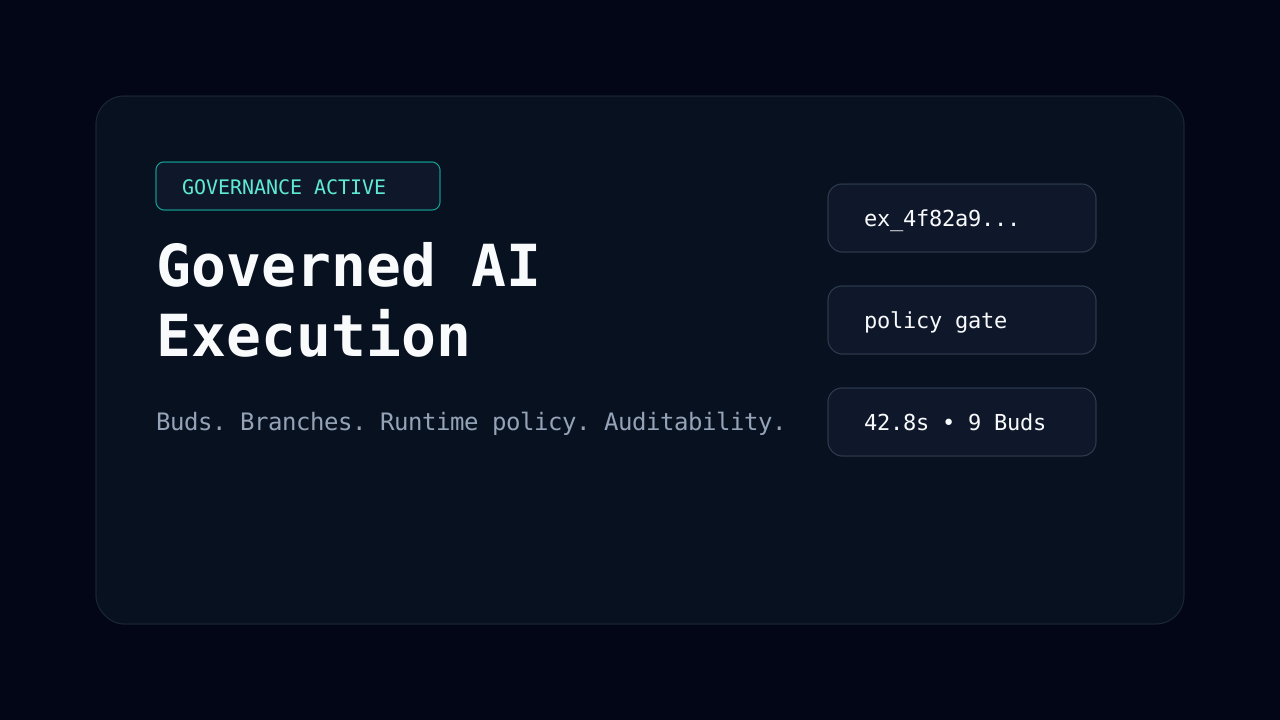
By separating intelligence from execution, Stackmint ensures that every AI decision passes through your company's compliance, legal, and routing policies before execution occurs. We allow your teams to keep the reasoning power of modern LLMs, while IT and Security retain absolute control over authority, spend, and execution paths.
Your company is a stack of capabilities. It's time to control them.
Ready to map this to your environment?
Stop paying for unpredictable compute and start deploying governed business outcomes.
Book an Architecture Briefing →