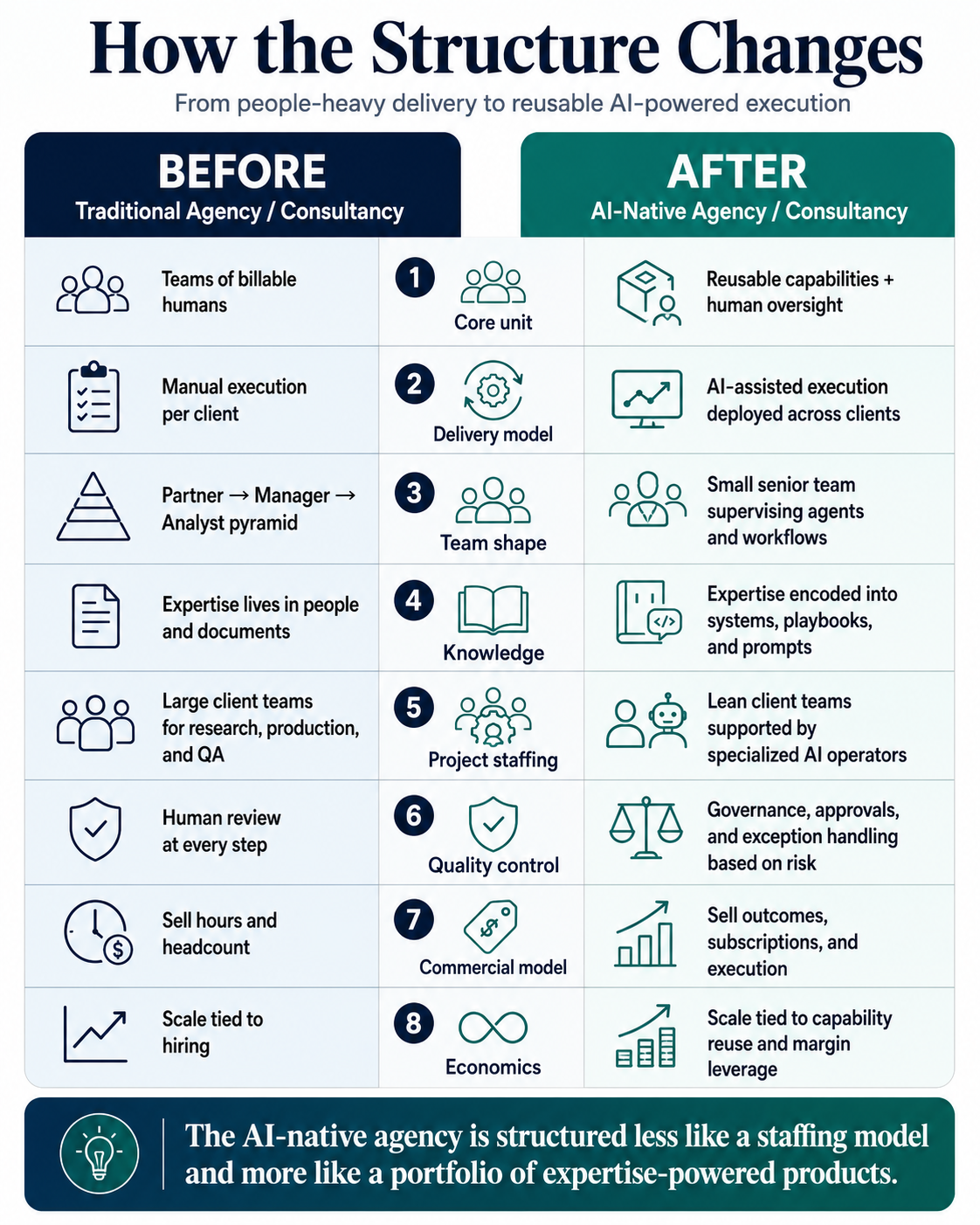
AI Recap:
A Core Shift: Becoming AI-native means decoupling output from human hours worked.
The New Model: Shift your thinking from "managing a team of AI agents" to "building an automated factory assembly line."
The Role of Humans: AI handles workflow execution and quality checks; humans provide accountability, judgment, and client relationship management.
The Implementation: Inventory your repeatable deliverables, build a Capability Library, and standardize client context as infrastructure.
What Does It Mean to Be an AI-Native Firm?
Being AI native entails decoupling the output from the number of hours worked. This is not a new philosophy, but for professional services companies, whether they're consultancies, agencies, executive search firms, law firms or pretty much anything else, it is only becoming possible now with AI - and with the right framework; and of course, a specialized harness like Stackmint.
The Factory Framework: Deconstructing the AI Assembly Line
In order to successfully make that transition, or launching a whole new AI native firm, you need to think about the problem differently; not by team, but by production chain. Leave humans aside for a minute. Imagine your company as factory with multiple assembly lines. Like in a factory, an assembly line is defined by inputs (raw materials), a process (stack of workflows, playbooks, etc), and outputs. In order to reach the right quality, you introduce QA checkpoints. And to reach the right quantity, you make sure enough raw materials get injected into the input.
Empirically, when doing an AI native transformation, your goal is to get as quickly as possible to a point where the process reaches the maximum output, with the minimum of items failing QA, at the minimum price. Of course, you can't usually optimize the three dimensions simultaneously, so the realistic goal is to reach the point where you are satisfied about the production line. A good rule of thumb is, it is 3-10x cheaper and faster than doing everything manually, depending on the process.
Now, let's decompose these components.
1. Inputs (Raw Materials & Client Context)
The Inputs are obviously tremendously important. Garbage in, Garbage out. You may or may not have control over them. Typical inputs in a law firm can include NDA redlines from clients, or for a consulting firm, a Request For Proposal. Sometimes, it can be the output from another assembly line.
2. Outputs (Deliverables & Unit Economics)
The Outputs are your deliverables. The revised contract. The response to the RFP. This is usually a piece of work that is directly linked to the firm's Unit Economics. (Number of RFPs replied to x Win Rate x Average RFP Value = RFP Revenue)
3. Process (Proprietary IP & Workflow Logic)
The Process is the series of steps which, repeated with a consistent type of Input, produces the Output consistently. The Process is where the intellectual property of the company lives. This is what makes it different. You need to own it and defend it at all costs. For our RFP example, the process could include ensuring the firm is able to deliver the work, making sure it makes economic sense to bid, estimating the winnability of the project, reformulating the asks and studying the dependencies, estimating the workload, building the proposal, getting it reviewed and approved, and sending it to the bidder. It may also involve stopping the process altogether (for instance if the company does a no-go). This is where most of the work lives.
4. QA & Governance (Human-in-the-Loop)
The QA is critical. Bad product quality can be extremely detrimental to your firm. In the law firm example, a bad contract review can seriously impact your clients and the reputation of your firm. This is why judgement and accountability are so important.
So what's the role of humans if we're building a factory? And why aren't we even talking about AI?
As it turns out, AI has different roles in this assembly line. It can ensure the inputs are correctly formatted to be ingested in the process. At every step of the process, it should make sure the conditions are met to move to the next step. At the end of the process, it should control the Output's form, substance, quality. It should rate the work, and if it doesn't meet the right conditions, send the work back to the appropriate stage of the process. Lastly, it should learn what made it good or bad so the process can be improved. In the AI world these actions are supported by specialized tools like process reinforcement and LLM as a judge. AI should also be able to call a human for help when unsure, an example of Human in the Loop.
Humans play a very different role. The role of the human, not unlike our factory example, is to make sure the process runs smoothly, to analyze the data about process operations and output quality (potentially helped by AI), to make judgement calls, and apply their human qualities: understanding of the firm's quality standard, tribal knowledge and know-how, understanding of the customer's requirements because they own the relationship, common sense, responsibility, ownership, accountability. A machine should not be made accountable, a human should.
So, the human owns the output of the assembly line, the AI does the work, and the AI native company is essentially a factory with different assembly lines across business Development, Sales, Marketing, HR, and the firm's Production of sellable deliverables which is specific to each firm. But what does it look like in practice?
Why AI "Teams" Fail (and Why Workflows Must Be Governed)
First, the nucleus changes from "team" to "humans + assembly lines". A consultant may manage a few assembly lines (which of course can contain AI workflows and agents). I would steer away from the anthropomorphism at this stage and avoid the thought of a consultant managing "a team of AI researchers, or analysts". It is an easy mental model, but creates problems on its own, because the AI models always tend to overstep. You want the opposite: to rein them in and get them to accomplish a specific mission by applying your company rules, not produce generic slop, or worse, wander around to try and fix issues that are not part of their process. A governed AI workflow based on Stackmint will keep every model in their lane. Instead of imagining a team of "AI copies of humans", map the assembly line to the atomic actions that need to happen, pick the best model for each action, and you have something scalable, auditable, that your team can rely on.
Step-by-Step: How to Build Your Capability Library
Then, make the inventory of your delivery, starting with the assets you produce. They can often be found on your SOW, client contracts, engagement letters, order forms... Every type of repeatable work. If it is not repeatable, and you don't intend to repeat it in the near future, don't force it. This is the first step. Start what generates value first. This is AI native, the concept of automating some of your delivery with AI. Then, focus on what takes the most time away from your teams.
Once you have made this inventory, consolidate it into a Capability Library. The capability library contains everything your company needs in order to generate the assembly lines.
Then, you need to start thinking of your Inputs, especially the client context, as infrastructure. If you're a marketing firm, it could be your client's logos, colors, favorite fonts; if you're a law firm, contract templates, commercial names, links to the privacy policies; for an executive search, job descriptions. These should be treated as records, consistently, and standardized. In Stackmint we use variables for this. When your workflow is created, because everything is in variables, the workflow will natively run for new clients.
You may start to see that your vision of your own business feels more industrialized. You will start to picture your assembly lines, and as a leader, your role will become to make sure they get enough inputs and deliver outputs with consistent quality, working with the assembly line managers. At that point, the commercial model may naturally shift from selling capacity (hours, man/days) to selling execution and outcomes. This is great sign you have made the turn to AI Native.